Call Us (877) 740-5028

Call Us (877) 740-5028
Call Us (877) 740-5028

Table of Contents
Every few years, a shift in computing infrastructure quietly changes how businesses operate. Right now, the combination of edge and cloud computing services is doing exactly that.
Edge computing processes data locally, right where it is created. Cloud computing services provide centralized scale and analytical depth that local infrastructure alone cannot sustain. Neither solves the full problem on its own. But together, they create something genuinely useful.
This piece looks at the best use cases for integrating edge with cloud computing services, where that integration is not theoretical but already delivering measurable results in retail, healthcare, manufacturing, media, and financial services.
Retail has always been a business of tight margins and high transaction volumes. Interruptions at the point of sale are inconvenient and expensive, and the edge-cloud combination addresses that directly.
Edge computing allows retail locations to handle inventory lookups, transaction approvals, and checkout flows locally, without depending on a live connection to a central environment. Connectivity in branch and retail settings is not always reliable; a network hiccup should not stop a checkout line. Edge ensures transactions continue during connectivity loss, keeping customer experience intact and operational data flowing even in degraded conditions.
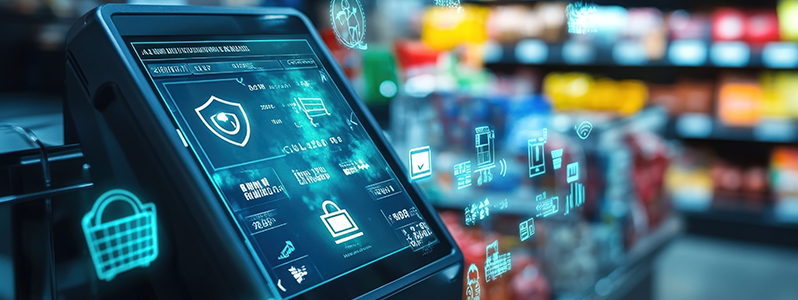
The edge handles the moment; the cloud handles the pattern. Once transaction and inventory data reach a central cloud environment, retailers gain a view across their entire network of what is selling where, which price adjustments are working, and how foot traffic varies by region.
This is precisely why, according to IDC’s 2025 Worldwide Edge Spending Guide, the Retail & Services sector accounts for nearly 28% of total global edge spending, the largest share of any industry. That investment reflects a practical recognition that cloud computing services and edge are not competing strategies but complementary ones.
Healthcare is a domain where latency can directly affect outcomes. Edge-cloud integration here addresses a problem that neither architecture handles well alone.
Wearable monitors and bedside sensors generate continuous data streams. Processing that data in the cloud introduces round-trip latency, a delay that becomes a real problem when a patient’s oxygen levels drop or a cardiac irregularity appears.
Edge devices handle this locally, running alert algorithms and threshold checks without waiting for a cloud response. The result is faster intervention, which is the entire point of remote patient monitoring.
Individual patient events are useful. Patterns across thousands of patients are transformative. Cloud environments enable healthcare systems to store longitudinal records, train diagnostic AI models on large datasets, and push updated models back to edge devices, a continuous loop that improves local performance over time.
According to Gartner, healthcare is one of the five leading industries in which the edge computing market is projected to grow from $131 billion in 2023 to $511 billion by 2033. Edge enables immediate alerts; cloud enables population health insights.
Manufacturing facilities are dense with sensors, machinery, and operational data. The industrial IoT case for edge-cloud integration is where the business case is clearest and most studied right now.
A factory floor cannot afford to wait for cloud-processed anomaly detection. When a motor begins vibrating outside expected parameters or a conveyor belt shows signs of wear, the response window is often seconds, not minutes.
Edge devices run inference models locally, flagging potential failures before they escalate. Local detection reduces unplanned downtime without requiring a persistent cloud connection for every decision.
The IDC 2025 update notes that the Manufacturing & Resources sector makes up about a quarter of worldwide edge spending, the second largest category globally, underscoring how actively industrial operators are investing in this architecture.
The edge model that catches one facility’s equipment failure is only as good as the data it was trained on. Cloud computing services enable manufacturers to aggregate sensor data from every facility, retrain machine learning models on a fuller dataset, and push improved models back to edge devices across the network.
Edge detects anomalies instantly; cloud refines algorithms across all sites. The loop between them is what makes predictive maintenance genuinely scalable.
Streaming video and interactive content are bandwidth-intensive and latency-sensitive. The edge-cloud split in media is one of the most technically mature applications of this integration model, and the most visible to end users.
Content delivery networks are, in many ways, the original edge computing use case, distributing content copies to servers geographically closer to end users. This reduces the distance data must travel and eliminates buffering for popular content.
For live streaming, gaming, and interactive applications, proximity matters a lot. An end user in a regional city should not experience more lag than one in a major metro simply because of where a content origin server sits.
On the other side, creating that content still requires centralized infrastructure. Rendering pipelines for animation and film, storage repositories for large media assets, and collaboration tools for distributed creative teams all rely on the scale that cloud computing services provide. End users get fast experiences; creators get scalable storage and compute. Neither side works well without the other.
In financial services, milliseconds have real dollar values. Fraud detection is one of the most demanding real-time workloads in any industry, and the edge-cloud model is becoming central to how banks and payment processors approach it.
A fraud scoring engine that takes 500 milliseconds to respond is a liability in a payment flow that users expect to complete in under two seconds. Edge deployments allow financial institutions to run initial transaction screening locally, checking velocity patterns, geographic flags, and behavioral signals, without routing every request to a central cloud environment. Edge stops fraud in milliseconds, and that speed is often the difference between catching a suspicious transaction and approving it.
Local models, however, only know what they have seen. Cloud environments allow fraud teams to analyze patterns across the entire transaction network, identify emerging attack vectors, and retrain fraud models continuously.
According to IDC, financial services is the fastest-growing segment in edge spending over the next five years, with a CAGR exceeding 15%, driven largely by augmented fraud analysis and investigation. Cloud identifies emerging threats globally and distributes updated detection logic back to edge nodes, a loop that keeps financial institutions ahead rather than behind.
Edge-cloud integration is not theoretical. Retail operations, healthcare systems, manufacturing facilities, media platforms, and financial institutions are all doing it right now. The business case for each is grounded in the same principle: put speed where it is needed, and depth where it belongs.
Businesses serious about extracting value from their cloud computing services need to think carefully about what happens at the edge. The two are not separate decisions.
At OTAVA, we design hybrid cloud and edge environments built to work together from the ground up. Our private cloud, hybrid cloud, and edge computing solutions are purpose-built for organizations that need security, compliance, and performance across distributed infrastructure. Connect with our team to discuss how our hybrid cloud solutions can support your edge computing initiatives and specific use cases. We will work with you to map out an architecture that fits your workloads, compliance requirements, and growth plans.